Eye Of Beholder
Pelit was a Finnish-language (bi)annual book series published from 1987 to 1991 containing gaming-related articles, tips and most importantly game reviews. Here you can find all the reviews from the books. The reviews were originally written in Finnish; the English versions are translations of the Finnish originals. Maininta tekijänoikeuksista
 1987
1987 1988
1988 1989 Kevät
 1989 Syksy
 1990 Kevät
 1990 Syksy
 1991 Kevät
 1991 Syksy
Eye Of Beholder
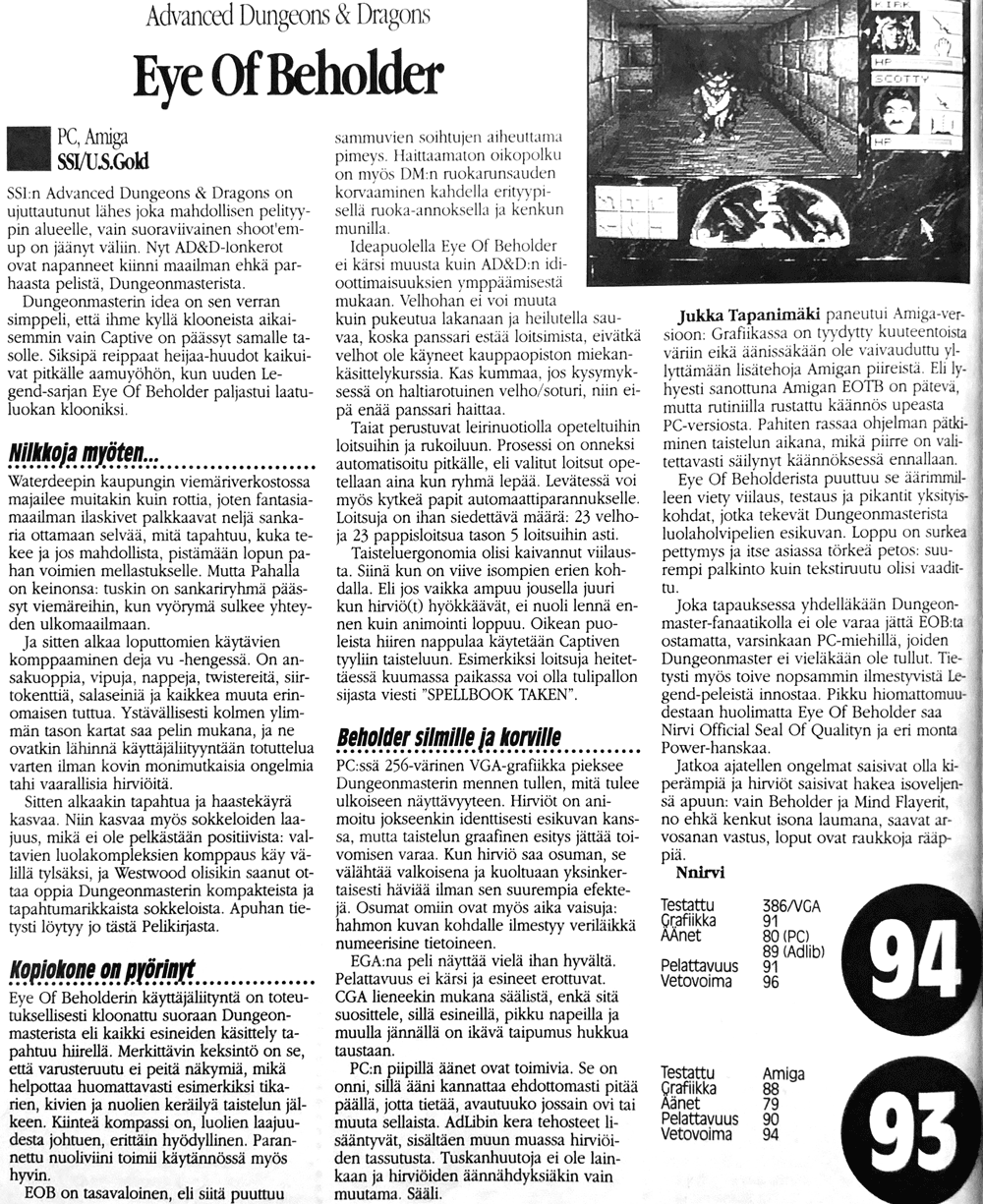
Eye Of Beholder1991 SyksyPysyvä linkkiSSI:n Advanced Dungeons & Dragons on ujuttautunut lähes joka mahdollisen pelityypin alueelle, vain suoraviivainen shoot'em-up on jäänyt väliin. Nyt AD&D-lonkerot ovat napanneet kiinni maailman ehkä parhaasta pelistä, Dungeonmasterista.
Dungeonmasterin idea on sen verran simppeli, että ihme kyllä klooneista aikaisemmin vain Captive on päässyt samalle tasolle. Siksipä reippaat heijaa-huudot kaikuivat pitkälle aamuyöhön, kun uuden Legend-sarjan Eye Of Beholder paljastui laatuluokan klooniksi.
Nilkkoja myöten...
Waterdeepin kaupungin viemäriverkostossa majailee muitakin kuin rottia, joten fantasiamaailman ilaskivet palkkaavat neljä sankaria ottamaan selvää, mitä tapahtuu, kuka tekee ja jos mahdollista, pistämään lopun pahan voimien mellastukselle. Mutta Pahalla on keinonsa: tuskin on sankariryhmä päässyt viemäreihin, kun vyörymä sulkee yhteyden ulkomaailmaan.
Ja sitten alkaa loputtomien käytävien komppaaminen deja vu -hengessä. On ansakuoppia, vipuja, nappeja, twistereitä, siirtokenttiä, salaseiniä ja kaikkea muuta erinomaisen tuttua. Ystävällisesti kolmen ylimmän tason kartat saa pelin mukana, ja ne ovatkin lähinnä käyttäjäliityyntään totuttelua varten ilman kovin monimutkaisia ongelmia tahi vaarallisia hirviöitä.
Sitten alkaakin tapahtua ja haastekäyrä kasvaa. Niin kasvaa myös sokkeloiden laajuus, mikä ei ole pelkästään positiivista: valtavien luolakompleksien komppaus käy välillä tylsäksi, ja Westwood olisikin saanut ottaa oppia Dungeonmasterin kompakteista ja tapahtumarikkaista sokkeloista. Apuhan tietysti löytyy jo tästä Pelikirjasta.
Kopiokone on pyörinyt
Eye Of Beholderin käyttäjäliityntä on toteutuksellisesti kloonattu suoraan Dungeonmasterista eli kaikki esineiden käsittely tapahtuu hiirellä. Merkittävin keksintö on se, että varusteruutu ei peitä näkymiä, mikä helpottaa huomattavasti esimerkiksi tikarien, kivien ja nuolien keräilyä taistelun jälkeen. Kiinteä kompassi on, luolien laajuudesta johtuen, erittäin hyödyllinen. Parannettu nuoliviini toimii käytännössä myös hyvin.
EOB on tasavaloinen, eli siitä puuttuu sammuvien soihtujen aiheuttama pimeys. Haittaamaton oikopolku on myös DM:n ruokarunsauden korvaaminen kahdella erityypisellä ruoka-annoksella ja kenkun munilla.
Ideapuolella Eye Of Beholder ei kärsi muusta kuin AD&D:n idioottimaisuuksien ymppäämisestä mukaan. Velhohan ei voi muuta kuin pukeutua lakanaan ja heilutella sauvaa, koska panssari estää loitsimista, eivätkä velhot ole käyneet kauppaopiston miekankäsittelykurssia. Kas kummaa, jos kysymyksessä on haltiarotuinen velho/soturi, niin eipä enää panssari haittaa.
Taiat perustuvat leirinuotiolla opeteltuihin loitsuihin ja rukoiluun. Prosessi on onneksi automatisoitu pitkälle, eli valitut loitsut opetellaan aina kun ryhmä lepää. Levätessä voi myös kytkeä papit automaattiparannukselle. Loitsuja on ihan siedettävä määrä: 23 velho- ja 23 pappisloitsua tason 5 loitsuihin asti.
Taisteluergonomia olisi kaivannut viilausta. Siinä kun on viive isompien erien kohdalla. Eli jos vaikka ampuu jousella juuri kun hirviö(t) hyökkäävät, ei nuoli lennä ennen kuin animointi loppuu. Oikean puoleista hiiren nappulaa käytetään Captiven tyyliin taisteluun. Esimerkiksi loitsuja heitettäessä kuumassa paikassa voi olla tulipallon sijasta viesti "SPELLBOOK TAKEN".
Beholder silmille ja korville
PC:ssä 256-värinen VGA-grafiikka pieksee Dungeonmasterin mennen tullen, mitä tulee ulkoiseen näyttävyyteen. Hirviöt on animoitu jokseenkin identtisesti esikuvan kanssa, mutta taistelun graafinen esitys jättää toivomisen varaa. Kun hirviö saa osuman, se välähtää valkoisena ja kuoltuaan yksinkertaisesti häviää ilman sen suurempia efektejä. Osumat omiin ovat myös aika vaisuja: hahmon kuvan kohdalle ilmestyy veriläikkä numeerisine tietoineen.
EGA:na peli näyttää vielä ihan hyvältä. Pelattavuus ei kärsi ja esineet erottuvat. CGA lieneekin mukana säälistä, enkä sitä suosittele, sillä esineillä, pikku napeilla ja muulla jännällä on ikävä taipumus hukkua taustaan.
PC:n piipillä äänet ovat toimivia. Se on onni, sillä ääni kannattaa ehdottomasti pitää päällä, jotta tietää, avautuuko jossain ovi tai muuta sellaista. AdLibin kera tehosteet lisääntyvät, sisältäen muun muassa hirviöiden tassutusta. Tuskanhuutoja ei ole lainkaan ja hirviöiden äännähdyksiäkin vain muutama. Sääli.
Jukka Tapanimäki paneutui Amiga-versioon: Grafiikassa on tyydytty kuuteentoista väriin eikä äänissäkään ole vaivauduttu yllyttämään lisätehoja Amigan piireistä. Eli lyhyesti sanottuna Amigan EOTB on pätevä, mutta rutiniilla rustattu käännös upeasta PC-versiosta. Pahiten rassaa ohjelman pätkiminen taistelun aikana, mikä piirre on valitettavasti säilynyt käännöksessä ennallaan.
Eye Of Beholderista puuttuu se äärimmilleen viety viilaus, testaus ja pikantit yksityiskohdat, jotka tekevät Dungeonmasterista luolaholvipelien esikuvan. Loppu on surkea pettymys ja itse asiassa törkeä petos: suurempi palkinto kuin tekstiruutu olisi vaadittu.
Joka tapauksessa yhdelläkään Dungeonmaster-fanaatikolla ei ole varaa jättä EOB:ta ostamatta, varsinkaan PC-miehillä, joiden Dungeonmaster ei vieläkään ole tullut. Tietysti myös toive nopsammin ilmestyvistä Legend-peleistä innostaa. Pikku hiomattomuudestaan huolimatta Eye Of Beholder saa Nirvi Official Seal Of Qualityn ja eri monta Power-hanskaa.
Jatkoa ajatellen ongelmat saisivat olla kiperämpiä ja hirviöt saisivat hakea isoveljensä apuun: vain Beholder ja Mind Flayerit, no ehkä kenkut isona laumana, saavat arvosanan vastus, loput ovat raukkoja rääppiä.
Eye Of Beholder1991 SyksyPermalinkSSI's Advanced Dungeons & Dragons has wormed its way into the territory of almost every possible type of game; only the straightforward shoot'em-up has been skipped. Now the AD&D tentacles have grabbed hold of perhaps the best game in the world, Dungeonmaster.
Dungeonmaster's idea is so simple that, oddly enough, only Captive among the earlier clones has made it to the same level. That's why rousing yippee-shouts echoed far into the small hours when Eye Of Beholder, from the new Legend series, turned out to be a quality-class clone.
Ankle-deep...
The sewer network of the city of Waterdeep is home to more than just rats, so the bigwigs of the fantasy world hire four heroes to find out what's going on, who's doing it and, if possible, to put an end to the rampaging of the forces of evil. But Evil has its ways: the band of heroes has barely got into the sewers when a cave-in cuts off the connection to the outside world.
And then the tramping of endless corridors begins, in a spirit of deja vu. There are pit traps, levers, buttons, twisters, teleport fields, secret walls and everything else exceedingly familiar. Kindly enough, the maps of the top three levels come with the game, and those levels are mainly for getting used to the user interface, without any very complicated problems nor dangerous monsters.
Then things really start happening and the challenge curve climbs. So does the size of the mazes, which isn't purely positive: tramping through huge cave complexes gets boring at times, and Westwood could well have taken a lesson from Dungeonmaster's compact and eventful mazes. Help, of course, is already to be found in this very Pelikirja.
The photocopier has been running
Implementation-wise, Eye Of Beholder's user interface has been cloned straight from Dungeonmaster, i.e. all handling of objects is done with the mouse. The most significant invention is that the equipment screen doesn't cover the view, which makes it considerably easier to, for example, collect daggers, rocks and arrows after a fight. The fixed compass is, owing to the size of the caves, extremely useful. The improved quiver also works well in practice.
EOB is evenly lit, meaning it lacks the darkness caused by torches burning out. Another harmless shortcut is replacing DM's abundance of food with two different kinds of rations and kenku eggs.
On the ideas side, Eye Of Beholder suffers from nothing except the grafting-in of AD&D's idiocies. The mage, you see, can do nothing but dress up in a bedsheet and wave a staff, because armour prevents spellcasting, and mages haven't taken the business college's swordsmanship course. Well, fancy that: if it's an elven mage/fighter, the armour suddenly doesn't get in the way any more.
Magic is based on spells learned at the campfire and on praying. Luckily the process has been largely automated, i.e. the chosen spells are learned whenever the party rests. While resting you can also switch the clerics to automatic healing. There's a perfectly tolerable number of spells: 23 mage and 23 cleric spells, up to level 5 spells.
The combat ergonomics could have used some fine-tuning. There's a lag, you see, in the bigger clashes. So if, say, you shoot your bow just as the monster(s) attack, the arrow won't fly until the animation ends. The right mouse button is used for fighting, Captive-style. When casting spells in a hot spot, for instance, instead of a fireball you may get the message "SPELLBOOK TAKEN".
Beholder for the eyes and ears
On the PC the 256-colour VGA graphics beat Dungeonmaster coming and going, as far as outward looks go. The monsters are animated more or less identically to the original, but the graphic presentation of combat leaves something to be desired. When a monster takes a hit it flashes white, and when it dies it simply vanishes without any further effects. Hits on your own party are also rather tame: a bloodstain with numerical details appears over the character's portrait.
In EGA the game still looks quite good. Playability doesn't suffer and the objects stand out. CGA is presumably included out of pity, and I don't recommend it, since objects, little buttons and other fun stuff have a nasty tendency to get lost in the background.
On the PC's beeper the sounds are serviceable. That's lucky, because you definitely want to keep the sound on so you know whether a door is opening somewhere, or something like that. With the AdLib the effects multiply, including among other things the padding of monsters' feet. There are no screams of pain at all, and only a few monster grunts. Pity.
Jukka Tapanimäki got stuck into the Amiga version: The graphics make do with sixteen colours, and nobody has bothered to coax any extra power out of the Amiga's chips for the sound either. So in short, the Amiga EOTB is a competent but routinely knocked-together conversion of the superb PC version. What grates most is the program stuttering during combat, a feature that has sadly survived the conversion unchanged.
Eye Of Beholder lacks the fine-tuning taken to the extreme, the testing and the piquant details that make Dungeonmaster the model for all dungeon-vault games. The ending is a miserable disappointment and in fact an outrageous swindle: a bigger reward than a text screen was called for.
In any case, no Dungeonmaster fanatic can afford to leave EOB unbought, least of all the PC men, whose Dungeonmaster still hasn't turned up. Naturally the hope of Legend games coming out at a brisker pace is exciting too. Despite its little rough edges, Eye Of Beholder gets the Nirvi Official Seal Of Quality and a great many Power gloves.
With the sequel in mind, the problems could be trickier and the monsters could go and fetch their big brothers to help: only the Beholder and the Mind Flayers - well, maybe the kenkus in a big pack - earn the grade of opponent; the rest are pitiful dregs.