1133 reviews from "Pelit"-books
Pelit was a Finnish-language (bi)annual book series published from 1987 to 1991 containing gaming-related articles, tips and most importantly game reviews. Here you can find all the reviews from the books. The reviews were originally written in Finnish; the English versions are translations of the Finnish originals. Maininta tekijänoikeuksista
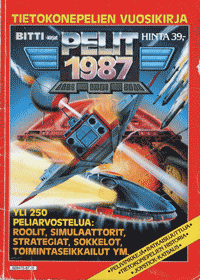 1987
1987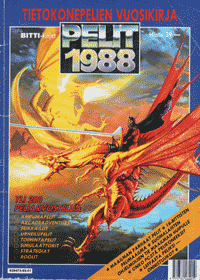 1988
1988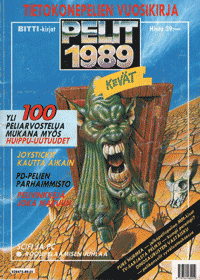 1989 Kevät
 1989 Syksy
 1990 Kevät
 1990 Syksy
 1991 Kevät
 1991 Syksy
10th Frame
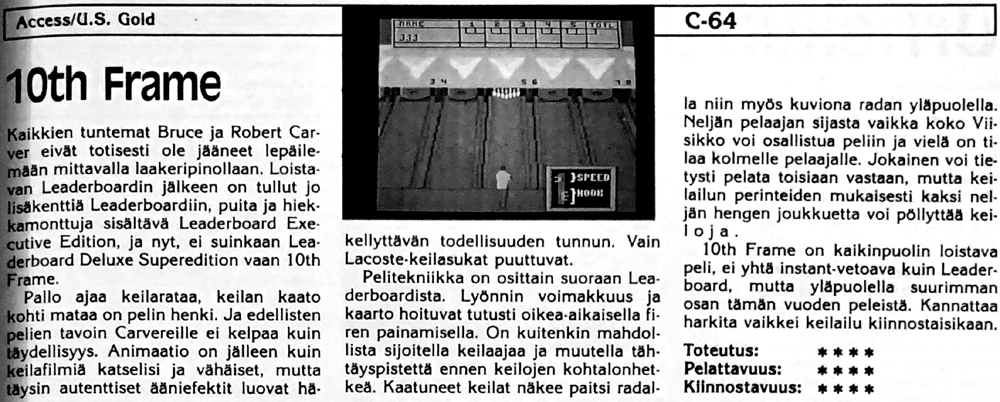
10th Frame1987Pysyvä linkkiKaikkien tuntemat Bruce ja Robert Carver eivät totisesti ole jääneet lepäilemään mittavalla laakeripinollaan. Loistavan Leaderboardin jälkeen on tullut jo lisäkenttiä Leaderboardiin, puita ja hiekkamonttuja sisältävä Leaderboard Executive Edition, ja nyt, ei suinkaan Leaderboard Deluxe Superedition vaan 10th Frame.
Pallo ajaa keilarataa, keilan kaato kohti mataa on pelin henki. Ja edellisten pelien tavoin Carvereille ei kelpaa kuin täydellisyys. Animaatio on jälleen kuin keilafilmiä katselisi ja vähäiset, mutta täysin autenttiset ääniefektit luovat häkellyttävän todellisuuden tunnun. Vain Lacoste-keilasukat puuttuvat.
Pelitekniikka on osittain suoraan Leaderboardista. Lyönnin voimakkuus ja kaarto hoituvat tutusti oikea-aikaisella firen painamisella. On kuitenkin mahdollista sijoitella keilaajaa ja muutella tähtäyspistettä ennen keilojen kohtalonhetkeä. Kaatuneet keilat näkee paitsi radalla niin myös kuviona radan yläpuolella. Neljän pelaajan sijasta vaikka koko Viisikko voi osallistua peliin ja vielä on tilaa kolmelle pelaajalle. Jokainen voi tietysti pelata toisiaan vastaan, mutta keilailun perinteiden mukaisesti kaksi neljän hengen joukkuetta voi pöllyttää keiloja.
10th Frame on kaikinpuolin loistava peli, ei yhtä instant-vetoava kuin Leaderboard, mutta yläpuolella suurimman osan tämän vuoden peleistä. Kannattaa harkita vaikkei keilailu kiinnostaisikaan.
10th Frame1987PermalinkBruce and Robert Carver, known to one and all, have certainly not sat back to rest on their sizeable pile of laurels. The brilliant Leaderboard has already been followed by extra courses for Leaderboard, then by Leaderboard Executive Edition with its trees and sand bunkers, and now - no, not Leaderboard Deluxe Superedition, but 10th Frame.
The ball rolling down the lane, the pin toppling to the floor: that is the spirit of the game. And as with their earlier games, nothing but perfection will do for the Carvers. Once again the animation is like watching a bowling film, and the sparse but utterly authentic sound effects create a startling sense of reality. Only the Lacoste bowling socks are missing.
The game mechanics are partly lifted straight from Leaderboard. The power and hook of the shot are handled in the familiar way, by pressing fire at the right moment. You can, however, position the bowler and shift the aiming point before the pins' moment of destiny. The knocked-down pins are shown not only on the lane but also as a diagram above it. Instead of four players, the whole Famous Five can join in, and there is still room for three more. Everyone can of course play against everyone else, but in keeping with bowling tradition two teams of four can also give the pins a good dusting.
10th Frame is a brilliant game all round - not as instantly gripping as Leaderboard, but a cut above most of this year's games. Worth considering even if you have no interest in bowling.
19 - Part One: Bootcamp
19 - Part One: Bootcamp1989 KevätPysyvä linkkiNineteenilla on kyseenalainen kunnia olla ensimmäinen nuorison suosiman popmusiikin mukaan tehty peli. Helppoa se ei liene ollut, sillä synnytystuskat ovat kestäneet kauan. Nyt on lapsesta puolikas syntynyt ja kakkososa putkahtaa myöhemmin.
Etukäteenhän Nineteenista kerrottiin tulevan Vietnamiin liittyvä taistelupeli, jossa aseistakieltäytyjille olisi ollut oma tekstipeliosuutensa. "Yllättäen" tulos onkin Combat Schoolin käynyt ja opit sisäistänyt multieepos.
Bootcamp on olevinaan uuden aamuteittisen sotilaskoulutusta. No mitenkä pojasta tehdään mies? Ensin uuden alokkaan on selviydyttävä esteradasta. Rataan kuuluu erilaisia putkia, esteitä, kipuamisia ja roikkumisia, joista selviydytään ahkeralla firen painamisella tai rytmikkäällä vasenoikea-variksenpoikia-joystickillä. Jakso sisältää suhteettoman vaikeita osioita, jotka helposti aiheuttavat vakavan pelikatkon.
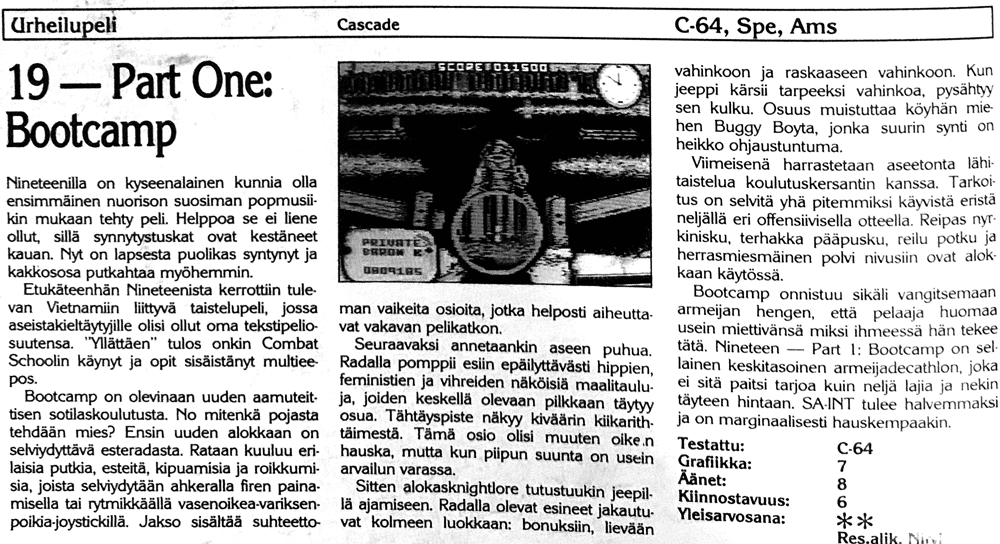
Seuraavaksi annetaankin aseen puhua. Radalla pomppii esiin epäilyttävästi hippien, feministien ja vihreiden näköisiä maalitauluja, joiden keskellä olevaan pilkkaan täytyy osua. Tähtäyspiste näkyy kiväärin kiikarithtäimestä. Tämä osio olisi muuten oikein hauska, mutta kun piipun suunta on usein arvailun varassa.
Sitten alokasknightlore tutustuukin jeepillä ajamiseen. Radalla olevat esineet jakautuvat kolmeen luokkaan: bonuksiin, lievään vahinkoon ja raskaaseen vahinkoon. Kun jeeppi kärsii tarpeeksi vahinkoa, pysähtyy sen kulku. Osuus muistuttaa köyhän miehen Buggy Boyta, jonka suurin synti on heikko ohjaustuntuma.
Viimeisenä harrastetaan aseetonta lähitaistelua koulutuskersantin kanssa. Tarkoitus on selvitä yhä pitemmiksi käyvistä eristä neljällä eri offensiivisella otteella. Reipas nyrkinisku, terhakka pääpusku, reilu potku ja herrasmiesmäinen polvi nivusiin ovat alokkaan käytössä.
Bootcamp onnistuu sikäli vangitsemaan armeijan hengen, että pelaaja huomaa usein miettivänsä miksi ihmeessä hän tekee tätä. Nineteen - Part 1: Bootcamp on sellainen keskitasoinen armeijadecathlon, joka ei sitä paitsi tarjoa kuin neljä lajia ja nekin täyteen hintaan. SA-INT tulee halvemmaksi ja on marginaalisesti hauskempaakin.
19 - Part One: Bootcamp1989 KevätPermalinkNineteen has the dubious honour of being the first game based on the pop music so beloved of the young. It can hardly have been easy, since the labour pains have dragged on for a long time. Now half of the baby has been born, and part two will pop out later.
Beforehand, of course, we were told Nineteen would be a Vietnam combat game, with a text-adventure section all of its own for conscientious objectors. "Surprisingly", the result turns out to be a multi-epic that has been through Combat School and taken its lessons to heart.
Bootcamp purports to be the military training of a brand-new rookie. So how do you make a man out of a boy? First the new recruit has to make it through the obstacle course. The course is made up of assorted pipes, hurdles, climbs and hangs, which you get past by diligently pressing fire or by rhythmic left-right-hup-two-three-four joystick work. The section contains disproportionately difficult stretches that can easily lead to a serious stoppage in play.
Next it's time to let the gun do the talking. Targets that look suspiciously like hippies, feminists and Greens pop up on the range, and you have to hit the bull's-eye in the middle of them. Your point of aim is shown in the rifle's telescopic sight. This section would otherwise be really good fun, except that where the barrel is pointing is often a matter of guesswork.
Then recruitknightlore gets acquainted with driving a jeep. The objects on the track fall into three categories: bonuses, light damage and heavy damage. Once the jeep has taken enough damage, it grinds to a halt. The stage is like a poor man's Buggy Boy, and its biggest sin is the feeble steering feel.
Last of all comes a spot of unarmed close combat with the drill sergeant. The idea is to survive ever-lengthening rounds using four different offensive moves. A brisk punch, a spirited headbutt, a good fair kick and a gentlemanly knee to the groin are at the recruit's disposal.
Bootcamp manages to capture the spirit of the army insofar as the player often catches themselves wondering why on earth they are doing this. Nineteen - Part 1: Bootcamp is a middling army decathlon that, what's more, offers only four events, and at full price at that. SA-INT works out cheaper and is marginally more fun, too.
1942
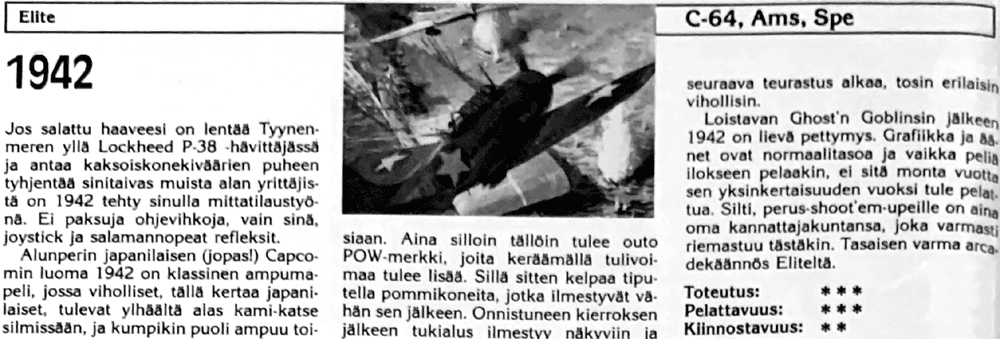
19421987Pysyvä linkkiJos salattu haaveesi on lentää Tyynenmeren yllä Lockheed P-38 -hävittäjässä ja antaa kaksoiskonekiväärien puheen tyhjentää sinitaivas muista alan yrittäjistä on 1942 tehty sinulla mittatilaustyönä. Ei paksuja ohjevihkoja, vain sinä, joystick ja salamannopeat refleksit.
Alunperin japanilaisen (jopas!) Capcomin luoma 1942 on klassinen ampumapeli, jossa viholliset, tällä kertaa japanilaiset, tulevat ylhäältä alas kami-katse silmissään, ja kumpikin puoli ampuu toisiaan. Aina silloin tällöin tulee outo POW-merkki, joita keräämällä tulivoimaa tulee lisää. Sillä sitten kelpaa tiputella pommikoneita, jotka ilmestyvät vähän sen jälkeen. Onnistuneen kierroksen jälkeen tukialus ilmestyy näkyviin ja seuraava teurastus alkaa, tosin erilaisin vihollisin.
Loistavan Ghost'n Goblinsin jälkeen 1942 on lievä pettymys. Grafiikka ja äänet ovat normaalitasoa ja vaikka peliä ilokseen pelaakin, ei sitä monta vuotta sen yksinkertaisuuden vuoksi tule pelattua. Silti, perus-shoot'em-upeille on aina oma kannattajakuntansa, joka varmasti riemastuu tästäkin. Tasaisen varma arcadekäännös Eliteltä.
19421987PermalinkIf your secret dream is to fly over the Pacific in a Lockheed P-38 fighter and let your twin machine guns do the talking until the blue sky is cleared of other entrepreneurs in the same line of business, then 1942 was made to measure for you. No thick instruction booklets, just you, a joystick and lightning-fast reflexes.
Originally created by the Japanese (fancy that!) Capcom, 1942 is a classic shoot-'em-up in which the enemies, Japanese this time, come down from the top of the screen with a kami-gaze in their eyes, and both sides shoot at each other. Every now and then a strange POW symbol turns up, and collecting these gives you more firepower. That comes in handy for knocking down the bombers that appear a little later. After a successful round the aircraft carrier comes into view and the next slaughter begins, albeit with different enemies.
After the brilliant Ghost'n Goblins, 1942 is a mild disappointment. The graphics and sound are standard fare, and although you will enjoy playing it, its simplicity means you won't still be playing it years from now. Still, basic shoot'em-ups always have their own band of followers, who will surely be delighted with this one too. A steady, reliable arcade conversion from Elite.
1943 - The Battle of Midway

1943 - The Battle of Midway1989 KevätPysyvä linkkiEnsin oli 1942, sitten tuli 1943-One Year After ja nyt tuleekin vaihteeksi taas 1943, eikä voi kun kysyä että miksi?
Jälleen kohoaa P-38 hohtaville siivilleen ja tuhoaa Japanin ilmavoimat useampaankin kertaan matkatessaan kohti taistelulaiva Yamotoa. Kuusi salaista asetta voi poimia matkalla mukaan, mukana legendaarinen "POW". Edelleen voi tiukoista tilanteista paeta tekemällä tiukka silmukka. Tason loppu-hirviötä vastaa luonnollisesti joko sotalaiva tai isommanpuoleinen lentokone, jotka kummatkin ovat joka tapauksessa suojattu laivasaattueella.
Erona 1942:een ei P-48 leviä tulipalloksi heti yhdestä osumasta, vaan vasta kun voimamittari valahtaa nollaan. Yhtäaikainen kahden hengen peli on myös kuusnelosessa mahdollista, mutta jostain syystä ei ST:ssä.
Kuusnelosen grafiikka ei ole mitenkään erikoista vaikka lentokoneet sellaisiksi tunnistaakin. Törmäystarkistus vähän lipsuu, sillä spritet eivät tunnu tajuavan koska pitää kuolla. Erikoisen häiritsevältä näyttää tapa, jolla isommat lentokoneet on liimattu merenpintaan. ST-versio on Proben käsialaa ja tosi pettymys. Firebirdin taidokkaan Flying Sharkin jälkeen 1943:n hyytysen kokoiset lentokoneet näyttävät surkeilta, ja simppeli grafiikka puuttuvine kaksinpelimahdollisuuksineen ei innosta pelaamaan.
Sinänsä 1943 on ihan sujuva, mutta turhan helppo (jopa minulle) ammuskelupeli, jota tuskin kannattaa liittää kenenkään kokoelmiin.
1943 - The Battle of Midway1989 KevätPermalinkFirst there was 1942, then came 1943-One Year After, and now, for a change, here comes 1943 again, and you can't help but ask: why?
Once again the P-38 rises on its gleaming wings and wipes out the Japanese air force several times over as it makes its way towards the battleship Yamoto. Six secret weapons can be picked up along the way, the legendary "POW" among them. You can still escape from tight spots by pulling a tight loop. The end-of-level monster is naturally played by either a warship or a largish aircraft, both of which are in any case protected by a naval escort.
Unlike in 1942, the P-48 doesn't go up in a fireball from a single hit, only once its energy meter sinks to zero. Simultaneous two-player play is also possible on the C-64, but for some reason not on the ST.
The C-64 graphics are nothing special, even if you can tell that the planes are planes. The collision detection slips a bit, as the sprites don't seem to grasp when they're supposed to die. Particularly jarring is the way the bigger aircraft have been glued to the surface of the sea. The ST version is Probe's handiwork and a real letdown. After Firebird's accomplished Flying Shark, 1943's mosquito-sized planes look pathetic, and the simple graphics, minus the two-player option, hardly inspire you to play.
As such, 1943 is a perfectly smooth but needlessly easy (even for me) shoot-'em-up that is hardly worth adding to anyone's collection.
1st Person Pinball
1st Person Pinball1990 SyksyPysyvä linkkiFlipperi Amigalle, ei kai Tynesoft ole tosissaan? Toisaalta kai antiikkisesta palloteluromustakin saa kohtuullisen pelin, kun heittää sekaan sopivasti innovaatioita. Tässä tapauksessa se tarkoittaa eräänlaisella vektorigrafiikalla toteutettua kolmiulotteista näkökulmaa.
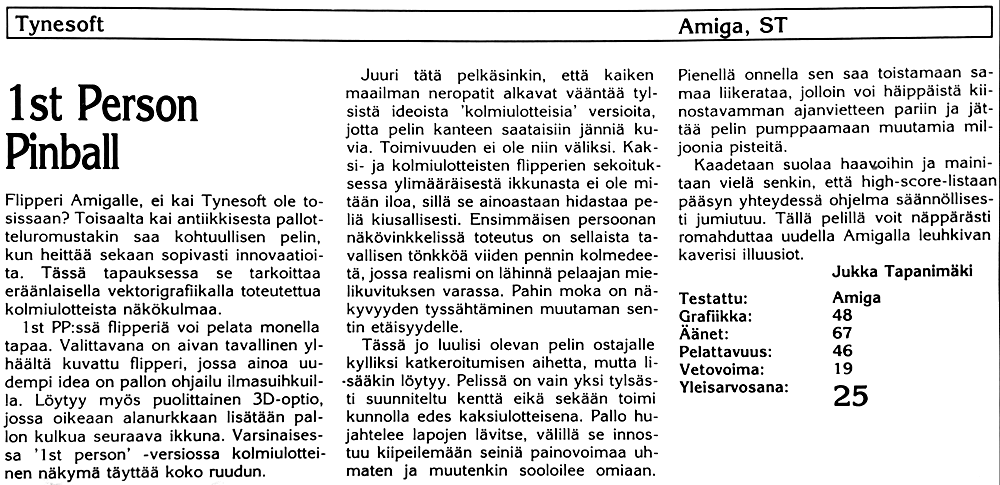
1st PP:ssä flipperiä voi pelata monella tapaa. Valittavana on aivan tavallinen ylhäältä kuvattu flipperi, jossa ainoa uudempi idea on pallon ohjailu ilmasuihkuilla. Löytyy myös puolittainen 3D-optio, jossa oikeaan alanurkkaan lisätään pallon kulkua seuraava ikkuna. Varsinaisessa '1st person' -versiossa kolmiulotteinen näkymä täyttää koko ruudun.
Juuri tätä pelkäsinkin, että kaiken maailman neropatit alkavat vääntää tylsistä ideoista 'kolmiulotteisia' versioita, jotta pelin kanteen saataisiin jänniä kuvia. Toimivuuden ei ole niin väliksi. Kaksi- ja kolmiulotteisten flipperien sekoituksessa ylimääräisestä ikkunasta ei ole mitään iloa, sillä se ainoastaan hidastaa peliä kiusallisesti. Ensimmäisen persoonan näkövinkkelissä toteutus on sellaista tavallisen tönkköä viiden pennin kolmedeetä, jossa realismi on lähinnä pelaajan mielikuvituksen varassa. Pahin moka on näkyvyyden tyssähtäminen muutaman sentin etäisyydelle.
Tässä jo luulisi olevan pelin ostajalle kylliksi katkeroitumisen aihetta, mutta lisääkin löytyy. Pelissä on vain yksi tylsästi suunniteltu kenttä eikä sekään toimi kunnolla edes kaksiulotteisena. Pallo hujahtelee lapojen lävitse, välillä se innostuu kiipeilemään seiniä painovoimaa uhmaten ja muutenkin sooloilee omiaan. Pienellä onnella sen saa toistamaan samaa liikerataa, jolloin voi häippäistä kiinnostavamman ajanvietteen pariin ja jättää pelin pumppaamaan muutamia miljoonia pisteitä.
Kaadetaan suolaa haavoihin ja mainitaan vielä senkin, että high-score-listaan pääsyn yhteydessä ohjelma säännöllisesti jumiutuu. Tällä pelillä voit näppärästi romahduttaa uudella Amigalla leuhkivan kaverisi illuusiot.
1st Person Pinball1990 SyksyPermalinkPinball on the Amiga - surely Tynesoft can't be serious? Then again, I suppose even an antique heap of ball-batting junk can be made into a reasonable game if you throw in a suitable dose of innovation. In this case that means a three-dimensional viewpoint done with a sort of vector graphics.
In 1st PP the pinball can be played in a number of ways. On offer is a perfectly ordinary top-down pinball table, where the only newer idea is steering the ball with air jets. There's also a halfway-house 3D option, which adds a window in the bottom right corner that follows the ball around. In the '1st person' version proper, the three-dimensional view fills the whole screen.
This is exactly what I was afraid of: every bright spark under the sun starting to twist boring ideas into 'three-dimensional' versions, just so there are exciting pictures to put on the box. Whether it actually works doesn't matter so much. In the mix of two- and three-dimensional pinball the extra window is no joy whatsoever, since all it does is slow the game down annoyingly. In the first-person perspective the execution is the usual clunky brand of two-bit three-dee, where the realism rests mainly on the player's imagination. The worst blunder is that visibility stops dead a few inches ahead.
You'd think that would already give the buyer reason enough to turn bitter, but there's more. The game has just one dully designed table, and even that doesn't work properly, not even in two dimensions. The ball whooshes straight through the flippers, every now and then it takes it into its head to climb the walls in defiance of gravity, and generally it goes off on solo excursions of its own. With a little luck you can get it to repeat the same trajectory, at which point you can push off to some more interesting pastime and leave the game pumping up a few million points.
Let's rub salt in the wounds and mention as well that the program regularly locks up when you make it onto the high-score list. With this game you can deftly shatter the illusions of that mate of yours who's been showing off with their new Amiga.
3D pool

3D pool1989 SyksyPysyvä linkkiPeliteollisuutta vaanivista taudeista tappavin on ideavajaus. Oiva apu oireisiin on vanhan idean vääntäminen uuteen hahmoon. Tällä kertaa kyseessä on biljardin laajentaminen kolmanteen ulottuvuuteen.
Biljardipöydällä voi pelata lukemattomia pelejä ja niiden muunnelmia. 3D Pooliin on valittu se laajimmin tunnettu, johon kuuluu kahden värisiä palloja ja musta kahdeksikko. Palloja pussitetaan joko toisen pelaajan tai tietokoneen kanssa, jonka ohjaamista pallonpyörittäjistä taitavin on elektroninen vastine Euroopan mestari Maltese Joelle. Jos pelaaminen ei kiinnosta, voi kokeilla valmiiksi laadittuja trikkilyöntejä tai rakennella sellaisia itse. Ylä-, ala- ja sivukierteitä tehokkaasti käyttämällä voi esittää hämmästyttäviä bravuureita.
Pöytä on kuvattu kohtuullisen sujuvasti pyörähtelevällä täytetyllä vektorigrafiikalla. Tosin se muistuttaa lähinnä minimalistista taideteosta, sillä nopeuden lisäämiseksi sitä on jätetty reunavallit pois. Pelaajan kärsivällisyyttä koettelee pahiten tietokonevastustaja, joka vaikeassa tilanteessa käyttää noin puoli minuuttia lyöntinsä laskemiseen.
Lyönnin tähtäämisessä ei käytetä apuvälineitä, vaan palloa lyödään aina suoraan eteenpäin, tarkemmin sanottuna ruudun yläreunaa kohti. Suunta määritelläänkin pyörittämällä pöytää pallon ympäri, mikä antaa hyvin realistisen tuntuman. Valitettavasti tähtääminen on välillä hieman liian epämääräistä, mistä saamme syyttää kuusnelosen värigrafiikan kehnoa erottelukykyä. Ongelman voisi kiertää muuttamalla katselupisteen etäisyyttä, mutta ikävä kyllä sitä voi siirtää vain kauemmaksi. Puutteen voisi korjata myös siirtymällä halutessaan tarkkuusgrafiikkaan, mitä mahdollisuutta pelissä valitettavasti ei ole.
Peli tasapainoilee urheasti kuusnelosen suorituskyvyn äärirajoilla, joten sen pieniin vajavaisuuksiin ei voi suhtautua kovin vakavasti. 3D Pool on pallokepitystä simuloivista peleistä ehdottomasti realistisin ja täydellisin, josta puuttuu vain savuisen peliluolan hämyinen tunnelma. Mutta jos laji ei kiinnosta, niin se on vain biljardi miljardien biljardien joukossa.
3D pool1989 SyksyPermalinkOf all the diseases stalking the games industry, the deadliest is idea deficiency. A fine remedy for the symptoms is twisting an old idea into a new shape. This time it's a matter of extending billiards into the third dimension.
Countless games and their variants can be played on a billiard table. 3D Pool has gone for the most widely known one, with balls of two colours and the black eight. You pot the balls against either another player or the computer, and the most skilful of the computer's ball-twirlers is an electronic counterpart of European champion Maltese Joe. If playing a match doesn't interest you, you can try ready-made trick shots or build your own. By making effective use of top, bottom and side spin you can pull off astonishing feats of bravura.
The table is depicted in filled vector graphics that rotate reasonably smoothly. Admittedly it mostly resembles a minimalist work of art, since the cushions have been left off to increase the speed. What tries the player's patience worst is the computer opponent, which in a tricky situation spends about half a minute calculating its shot.
No aiming aids are used when lining up a shot; the ball is always struck straight ahead, or more precisely towards the top edge of the screen. So the direction is set by rotating the table around the ball, which gives a very realistic feel. Unfortunately the aiming is at times a little too vague, for which we can blame the poor resolution of the Commodore 64's colour graphics. The problem could be got round by changing the distance of the viewpoint, but sadly it can only be moved further away. The shortcoming could also be fixed by letting you switch to hi-res graphics when you wanted, an option the game unfortunately doesn't have.
The game bravely balances on the outer limits of the Commodore 64's performance, so its small shortcomings can't be taken very seriously. Of all the games simulating ball-and-stick poking, 3D Pool is definitely the most realistic and complete, missing only the murky atmosphere of a smoky pool hall. But if the sport doesn't interest you, it's just one billiards among billions of billiards.
4D Sports: Boxing
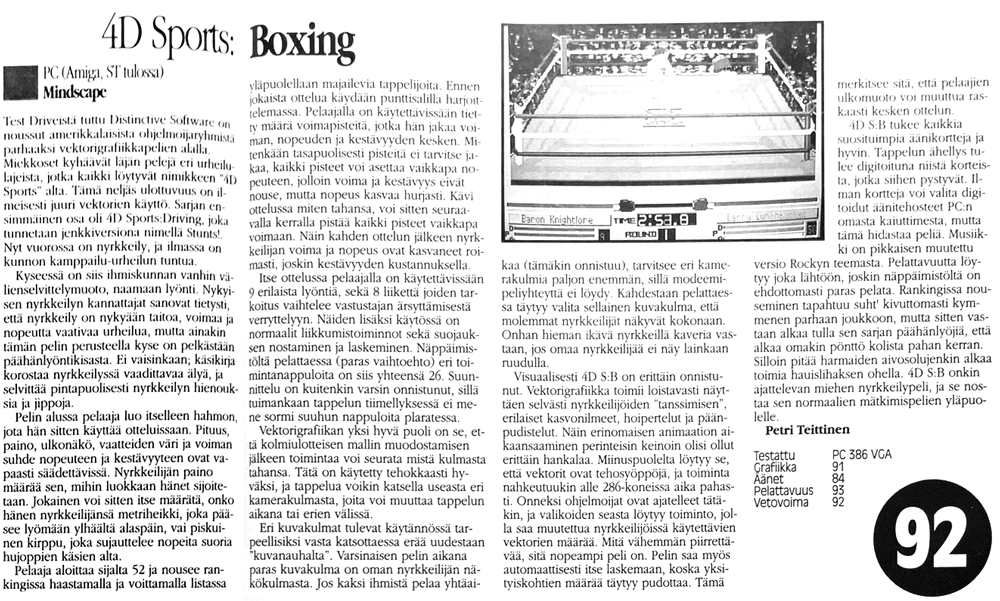
4D Sports: Boxing1991 SyksyPysyvä linkkiTest Driveistä tuttu Distinctive Software on noussut amerikkalaisista ohjelmoijaryhmistä parhaaksi vektorigrafiikkapelien alalla. Miekkoset kyhäävät läjän pelejä eri urheilulajeista, jotka kaikki löytyvät nimikkeen "4D Sports" alta. Tämä neljäs ulottuvuus on ilmeisesti juuri vektorien käyttö. Sarjan ensimmäinen osa oli 4D Sports:Driving, joka tunnetaan jenkkiversiona nimellä Stunts!. Nyt vuorossa on nyrkkeily, ja ilmassa on kunnon kamppailu-urheilun tuntua.
Kyseessä on siis ihmiskunnan vanhin välienselvittelymuoto, naamaan lyönti. Nykyisen nyrkkeilyn kannattajat sanovat tietysti, että nyrkkeily on nykyään taitoa, voimaa ja nopeutta vaativaa urheilua, mutta ainakin tämän pelin perusteella kyse on pelkästään päähänlyöntikisasta. Ei vaisinkaan; käsikirja korostaa nyrkkeilyssä vaadittavaa älyä, ja selvittää pintapuolisesti nyrkkeilyn hienouksia ja jippoja.
Pelin alussa pelaaja luo itselleen hahmon, jota hän sitten käyttää otteluissaan. Pituus, paino, ulkonäkö, vaatteiden väri ja voiman suhde nopeuteen ja kestävyyteen ovat vapaasti säädettävissä. Nyrkkeilijän paino määrää sen, mihin luokkaan hänet sijoitetaan. Jokainen voi sitten itse määrätä, onko hänen nyrkkeilijänsä metriheikki, joka pääsee lyömään ylhäältä alaspäin, vai piskuinen kirppu, joka sujauttelee nopeita suoria hujoppien käsien alta.
Pelaaja aloittaa sijalta 52 ja nousee rankingissa haastamalla ja voittamalla listassa yläpuolellaan majailevia tappelijoita. Ennen jokaista ottelua käydään punttisalilla harjoittelemassa. Pelaajalla on käytettävissään tietty määrä voimapisteitä, jotka hän jakaa voiman, nopeuden ja kestävyyden kesken. Mitenkään tasapuolisesti pisteitä ei tarvitse jakaa, kaikki pisteet voi asettaa vaikkapa nopeuteen, jolloin voima ja kestävyys eivät nouse, mutta nopeus kasvaa hurjasti. Kävi ottelussa miten tahansa, voi sitten seuraavalla kerralla pistää kaikki pisteet vaikkapa voimaan. Näin kahden ottelun jälkeen nyrkkeilijän voima ja nopeus ovat kasvaneet roimasti, joskin kestävyyden kustannuksella.
Itse ottelussa pelaajalla on käytettävissään 9 erilaista lyöntiä, sekä 8 liikettä joiden tarkoitus vaihtelee vastustajan ärsyttämisestä verryttelyyn. Näiden lisäksi käytössä on normaalit liikkumistoiminnot sekä suojauksen nostaminen ja laskeminen. Näppäimistöltä pelattaessa (paras vaihtoehto) eri toimintanappuloita on siis yhteensä 26. Suunnittelu on kuitenkin varsin onnistunut, sillä tuimankaan tappelun tiimellyksessä ei mene sormi suuhun nappuloita plaratessa.
Vektorigrafiikan yksi hyvä puoli on se, että kolmiulotteisen mallin muodostamisen jälkeen toimintaa voi seurata mistä kulmasta tahansa. Tätä on käytetty tehokkaasti hyväksi, ja tappelua voikin katsella useasta eri kamerakulmasta, joita voi muuttaa tappelun aikana tai erien välissä.
Eri kuvakulmat tulevat käytännössä tarpeellisiksi vasta katsottaessa erää uudestaan "kuvanauhalta". Varsinaisen pelin aikana paras kuvakulma on oman nyrkkeilijän näkökulmasta. Jos kaksi ihmistä pelaa yhtäaikaa (tämäkin onnistuu), tarvitsee eri kamerakulmia paljon enemmän, sillä modeemipeliyhteyttä ei löydy. Kahdestaan pelattaessa täytyy valita sellainen kuvakulma, että molemmat nyrkkeilijät näkyvät kokonaan. Onhan hieman ikävä nyrkkeillä kaveria vastaan, jos omaa nyrkkeilijää ei näy lainkaan ruudulla.
Visuaalisesti 4D S:B on erittäin onnistunut. Vektorigrafiikka toimii loistavasti näyttäen selvästi nyrkkeilijöiden "tanssimisen", erilaiset kasvonilmeet, hoipertelut ja päänpudistelut. Näin erinomaisen animaation aikaansaaminen perinteisin keinoin olisi ollut erittäin hankalaa. Miinuspuolelta löytyy se, että vektorit ovat tehosyöppöjä, ja toiminta nahkeutuukin alle 286-koneissa aika pahasti. Onneksi ohjelmoijat ovat ajatelleet tätäkin, ja valikoiden seasta löytyy toiminto, jolla saa muutettua nyrkkeilijöissä käytettävien vektorien määrää. Mitä vähemmän piirrettävää, sitä nopeampi peli on. Pelin saa myös automaattisesti itse laskemaan, koska yksityiskohtien määrää täytyy pudottaa. Tämä merkitsee sitä, että pelaajien ulkomuoto voi muuttua raskaasti kesken ottelun.
4D S:B tukee kaikkia suosituimpia äänikortteja ja hyvin. Tappelun ähellys tulee digitoituna niistä korteista, jotka siihen pystyvät. Ilman kortteja voi valita digitoidut äänitehosteet PC:n omasta kaiuttimesta, mutta tämä hidastaa peliä. Musiikki on pikkaisen muutettu versio Rockyn teemasta. Pelattavuutta löytyy joka lähtöön, joskin näppäimistöltä on ehdottomasti paras pelata. Rankingissa nouseminen tapahtuu suht' kivuttomasti kymmenen parhaan joukkoon, mutta sitten vastaan alkaa tulla sen sarjan päähänlyöjiä, että alkaa omakin pönttö kolista pahan kerran. Silloin pitää harmaiden aivosolujenkin alkaa toimia hauislihaksen ohella. 4D S:B onkin ajattelevan miehen nyrkkeilypeli, ja se nostaa sen normaalien mätkimispelien yläpuolelle.
4D Sports: Boxing1991 SyksyPermalinkDistinctive Software, familiar from Test Drive, has risen to become the best of the American programming teams in the field of vector graphics games. The chaps are knocking together a pile of games covering different sports, all of which come under the "4D Sports" banner. This fourth dimension is apparently the use of vectors itself. The first part of the series was 4D Sports:Driving, known in its Yank version as Stunts!. Now it's boxing's turn, and there's a real whiff of combat sport in the air.
So what we have here is humanity's oldest way of settling differences: the punch in the face. Supporters of modern boxing will of course say that these days boxing is a sport demanding skill, strength and speed, but judging at least by this game it's nothing but a contest in hitting people on the head. Not a bit of it; the manual stresses the brains that boxing demands, and gives a surface-level rundown of its finer points and tricks.
At the start of the game the player creates a character, whom they then use in their bouts. Height, weight, looks, the colour of the kit and the balance of strength against speed and stamina can all be freely adjusted. The boxer's weight decides which class they are placed in. Everyone can then decide for themselves whether their boxer is a towering giant who gets to punch downwards from above, or a tiny flea who slips quick straights in under the beanpoles' arms.
The player starts at number 52 and climbs the rankings by challenging and beating the scrappers camped above them on the list. Before every bout it's off to the weights room to train. The player has a set number of power points, which they share out between strength, speed and stamina. There's no need to share the points out at all evenly: you can put every single point into, say, speed, in which case strength and stamina don't go up but speed shoots up wildly. However the bout turns out, next time you can then put all the points into, say, strength. That way, after two bouts the boxer's strength and speed have grown massively, albeit at the expense of stamina.
In the bout itself the player has 9 different punches at their disposal, plus 8 moves whose purpose ranges from winding up the opponent to limbering up. On top of these there are the normal movement controls, plus raising and lowering the guard. Playing from the keyboard (the best option), that makes 26 different action keys in all. The layout is pretty well thought out, though, since even in the thick of the fiercest scrap you're never left stumped, fumbling through the keys.
One good thing about vector graphics is that once the three-dimensional model has been built, the action can be followed from any angle at all. This has been put to effective use, and the fight can be watched from several different camera angles, which can be switched during the fight or between rounds.
In practice the different angles only become necessary when you watch a round again "on tape". During actual play the best view is from your own boxer's point of view. If two people play at once (that works too), you need the different camera angles a lot more, since there's no modem link. When playing two-up you have to pick an angle where both boxers are fully visible. It is a bit of a drag boxing against a mate if your own boxer doesn't appear on the screen at all.
Visually 4D S:B is a real success. The vector graphics work brilliantly, clearly showing the boxers' "dancing", their various facial expressions, the staggering and the head-shaking. Pulling off animation this good by traditional means would have been extremely tricky. On the minus side, vectors are power guzzlers, and the action gets pretty badly sluggish on anything below a 286. Luckily the programmers have thought of this too, and among the menus there's an option for changing the number of vectors used for the boxers. The less there is to draw, the faster the game. You can also have the game work out for itself when the level of detail needs dropping. This means the players' appearance can change drastically in the middle of a bout.
4D S:B supports all the most popular sound cards, and supports them well. The grunting of the fight comes out digitised on those cards that are up to it. Without a card you can choose digitised sound effects through the PC's own speaker, but this slows the game down. The music is a slightly altered version of the Rocky theme. There's playability to suit every taste, though the keyboard is definitely the best way to play. Climbing the rankings into the top ten goes fairly painlessly, but then you start running into head-punchers of such a calibre that your own noggin starts rattling something awful. That's when the grey cells have to start working alongside the biceps. 4D S:B is, in fact, the thinking man's boxing game, and that lifts it above the ordinary slugfests.
4th & Inches
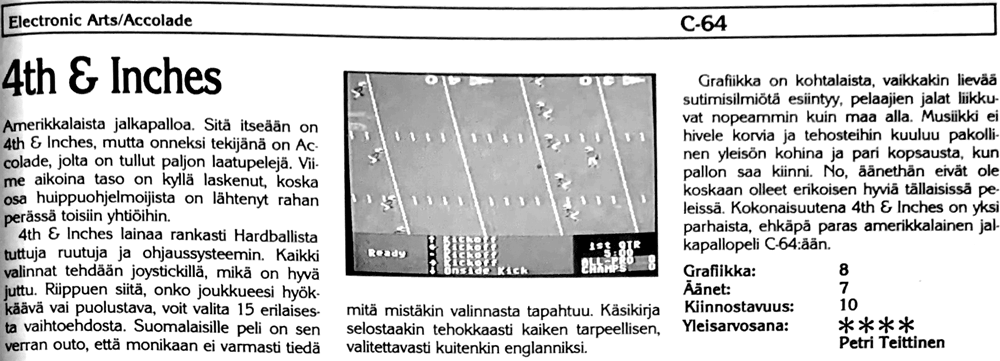
4th & Inches1988Pysyvä linkkiAmerikkalaista jalkapalloa. Sitä itseään on 4th & Inches, mutta onneksi tekijänä on Accolade, jolta on tullut paljon laatupelejä. Viime aikoina taso on kyllä laskenut, koska osa huippuohjelmoijista on lähtenyt rahan perässä toisiin yhtiöihin.
4th & Inches lainaa rankasti Hardballista tuttuja ruutuja ja ohjaussysteemin. Kaikki valinnat tehdään joystickillä, mikä on hyvä juttu. Riippuen siitä, onko joukkueesi hyökkäävä vai puolustava, voit valita 15 erilaisesta vaihtoehdosta. Suomalaisille peli on sen verran outo, että monikaan ei varmasti tiedä mitä mistäkin valinnasta tapahtuu. Käsikirja selostaakin tehokkaasti kaiken tarpeellisen, valitettavasti kuitenkin englanniksi.
Grafiikka on kohtalaista, vaikkakin lievää sutimisilmiötä esiintyy, pelaajien jalat liikkuvat nopeammin kuin maa alla. Musiikki ei hivele korvia ja tehosteihin kuuluu pakollinen yleisön kohina ja pari kopsausta, kun pallon saa kiinni. No, äänethän eivät ole koskaan olleet erikoisen hyviä tällaisissä peleissä. Kokonaisuutena 4th & Inches on yksi parhaista, ehkäpä paras amerikkalainen jalkapallopeli C-64:ään.
4th & Inches1988PermalinkAmerican football. That's exactly what 4th & Inches is, but luckily it's made by Accolade, who have turned out plenty of quality games. Admittedly the standard has dropped lately, because some of their top programmers have gone off to other companies, chasing the money.
4th & Inches borrows heavily from Hardball, lifting both its familiar screens and its control system. All the choices are made with the joystick, which is a good thing. Depending on whether your team is on offence or on defence, you can choose from 15 different options. The game is so alien to Finns that plenty of people certainly won't know what any given choice actually does. The manual does explain everything you need efficiently, though unfortunately in English.
The graphics are fair, although there's a mild wheelspin effect: the players' legs move faster than the ground beneath them. The music doesn't exactly caress the ears, and the effects consist of the obligatory crowd noise and a couple of thuds when you catch the ball. Well, sound has never been particularly good in games like this anyway. All in all, 4th & Inches is one of the best, maybe even the best, American football game for the C-64.
688 Attack Sub
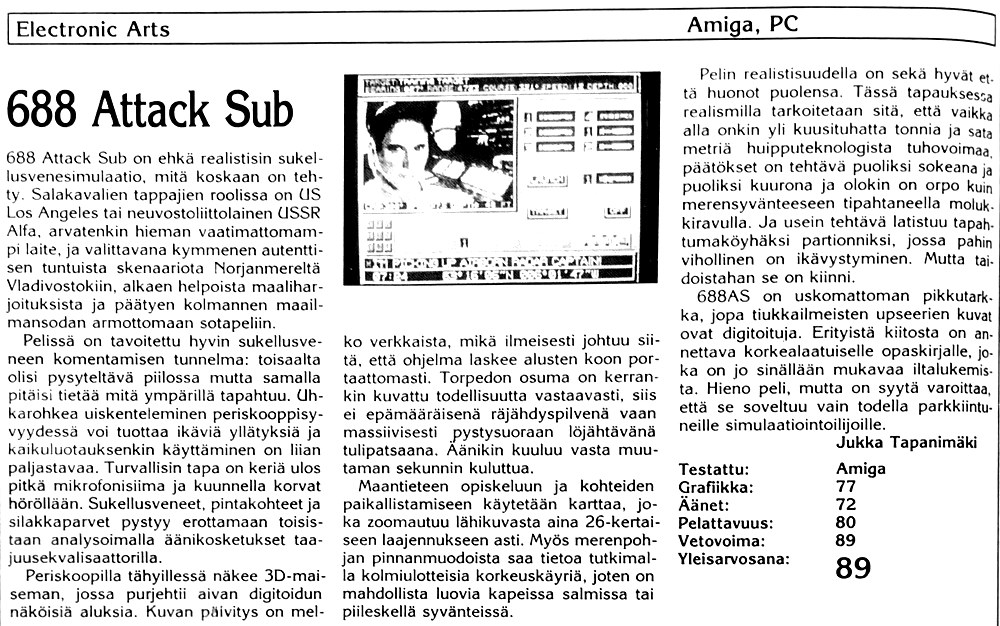
688 Attack Sub1990 SyksyPysyvä linkki688 Attack Sub on ehkä realistisin sukellusvenesimulaatio, mitä koskaan on tehty. Salakavalien tappajien roolissa on US Los Angeles tai neuvostoliittolainen USSR Alfa, arvatenkin hieman vaatimattomampi laite, ja valittavana kymmenen autenttisen tuntuista skenaariota Norjanmereltä Vladivostokiin, alkaen helpoista maaliharjoituksista ja päätyen kolmannen maailmansodan armottomaan sotapeliin.
Pelissä on tavoitettu hyvin sukellusveneen komentamisen tunnelma: toisaalta olisi pysyteltävä piilossa mutta samalla pitäisi tietää mitä ympärillä tapahtuu. Uhkarohkea uiskenteleminen periskooppisyvyydessä voi tuottaa ikäviä yllätyksiä ja kaikuluotauksenkin käyttäminen on liian paljastavaa. Turvallisin tapa on keriä ulos pitkä mikrofonisiima ja kuunnella korvat höröllään. Sukellusveneet, pintakohteet ja silakkaparvet pystyy erottamaan toisistaan analysoimalla äänikosketukset taajuusekvalisaattorilla.
Periskoopilla tähyillessä näkee 3D-maiseman, jossa purjehtii aivan digitoidun näköisiä aluksia. Kuvan päivitys on melko verkkaista, mikä ilmeisesti johtuu siitä, että ohjelma laskee alusten koon portaattomasti. Torpedon osuma on kerrankin kuvattu todellisuutta vastaavasti, siis ei epämääräisenä räjähdyspilvenä vaan massiivisesti pystysuoraan löjähtävänä tulipatsaana. Äänikin kuuluu vasta muutaman sekunnin kuluttua.
Maantieteen opiskeluun ja kohteiden paikallistamiseen käytetään karttaa, joka zoomautuu lähikuvasta aina 26-kertaiseen laajennukseen asti. Myös merenpohjan pinnanmuodoista saa tietoa tutkimalla kolmiulotteisia korkeuskäyriä, joten on mahdollista luovia kapeissa salmissa tai piileskellä syvänteissä.
Pelin realistisuudella on sekä hyvät että huonot puolensa. Tässä tapauksessa realismilla tarkoitetaan sitä, että vaikka alla onkin yli kuusituhatta tonnia ja sata metriä huipputeknologista tuhovoimaa, päätökset on tehtävä puoliksi sokeana ja puoliksi kuurona ja olokin on orpo kuin merensyvänteeseen tipahtaneella molukkiravulla. Ja usein tehtävä latistuu tapahtumaköyhäksi partionniksi, jossa pahin vihollinen on ikävystyminen. Mutta taidoistahan se on kiinni.
688AS on uskomattoman pikkutarkka, jopa tiukkailmeisten upseerien kuvat ovat digitoituja. Erityistä kiitosta on annettava korkealaatuiselle opaskirjalle, joka on jo sinällään mukavaa iltalukemista. Hieno peli, mutta on syytä varoittaa, että se soveltuu vain todella parkkiintuneille simulaatiointoilijoille.
688 Attack Sub1990 SyksyPermalink688 Attack Sub is perhaps the most realistic submarine simulation ever made. Cast as the stealthy killers are the US Los Angeles or the Soviet USSR Alfa, presumably a somewhat more modest piece of kit, and there are ten authentic-feeling scenarios to choose from, stretching from the Norwegian Sea to Vladivostok, starting with easy target practice and ending with the merciless war game of World War Three.
The game captures the feel of commanding a submarine well: on the one hand you ought to stay hidden, but at the same time you need to know what's going on around you. Daredevil paddling about at periscope depth can bring nasty surprises, and even using the echo sounder gives too much away. The safest way is to reel out a long microphone line and listen with your ears pricked. Submarines, surface targets and shoals of herring can be told apart by analysing the sound contacts with a frequency equaliser.
Peering through the periscope you see a 3D seascape with ships sailing through it that look downright digitised. The screen updates fairly leisurely, which is apparently because the program scales the ships smoothly rather than in steps. For once a torpedo hit is depicted the way it really looks, meaning not as a vague cloud of explosion but as a massive pillar of fire whumping straight up. The sound doesn't reach you until a few seconds later, either.
For studying geography and locating targets there's a map that zooms from a close-up all the way out to a 26-fold enlargement. You can also learn the lie of the sea floor by studying three-dimensional contour lines, so it's possible to thread your way through narrow straits or lurk in the deeps.
The game's realism has both its good and its bad sides. In this case realism means that even though you have over six thousand tonnes and a hundred metres of high-tech destructive power beneath you, decisions have to be made half blind and half deaf, and you feel as forlorn as a horseshoe crab dropped into an ocean trench. And the mission often flattens out into uneventful patrolling where the worst enemy is boredom. But then, it all comes down to skill.
688AS is incredibly meticulous; even the pictures of the stern-faced officers are digitised. Special praise has to go to the high-quality manual, which makes pleasant bedtime reading in its own right. A fine game, but fair warning: it's only suitable for truly hardened simulation buffs.
688 Attack Sub
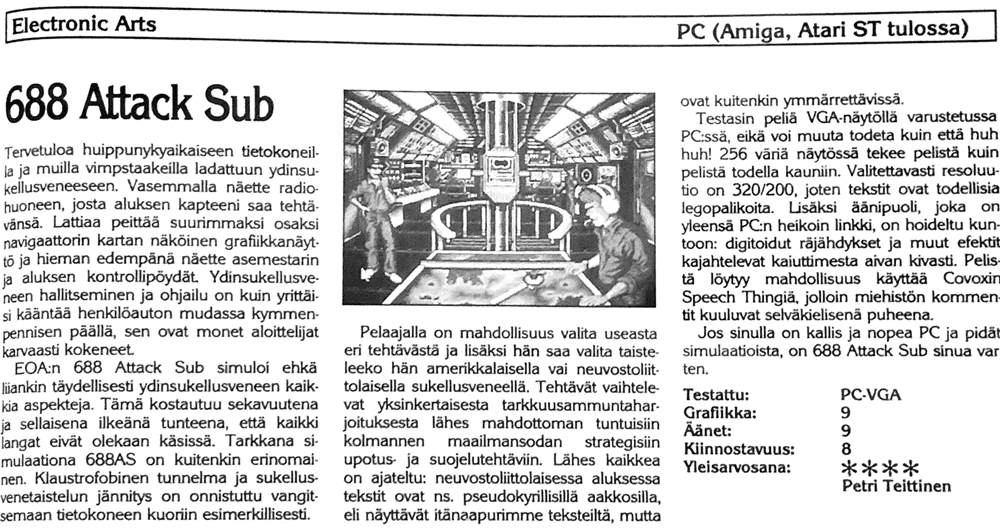
688 Attack Sub1989 SyksyPysyvä linkkiTervetuloa huippunykyaikaiseen tietokoneilla ja muilla vimpstaakeilla ladattuun ydinsukellusveneeseen. Vasemmalla näette radiohuoneen, josta aluksen kapteeni saa tehtävänsä. Lattiaa peittää suurimmaksi osaksi navigaattorin kartan näköinen grafiikkanäyttö ja hieman edempänä näette asemestarin ja aluksen kontrollipöydät. Ydinsukellusveneen hallitseminen ja ohjailu on kuin yrittäisi kääntää henkilöauton mudassa kymmenpennisen päällä, sen ovat monet aloittelijat karvaasti kokeneet.
EOA:n 688 Attack Sub simuloi ehkä liiankin täydellisesti ydinsukellusveneen kaikkia aspekteja. Tämä kostautuu sekavuutena ja sellaisena ilkeänä tunteena, että kaikki langat eivät olekaan käsissä. Tarkkana simulaationa 688AS on kuitenkin erinomainen. Klaustrofobinen tunnelma ja sukellusvenetaistelun jännitys on onnistuttu vangitsemaan tietokoneen kuoriin esimerkillisesti.
Pelaajalla on mahdollisuus valita useasta eri tehtävästä ja lisäksi hän saa valita taisteleeko hän amerikkalaisella vai neuvostoliittolaisella sukellusveneellä. Tehtävät vaihtelevat yksinkertaisesta tarkkuusammuntaharjoituksesta lähes mahdottoman tuntuisiin kolmannen maailmansodan strategisiin upotus- ja suojelutehtäviin. Lähes kaikkea on ajateltu: neuvostoliittolaisessa aluksessa tekstit ovat ns. pseudokyrillisillä aakkosilla, eli näyttävät itänaapurimme teksteiltä, mutta ovat kuitenkin ymmärrettävissä.
Testasin peliä VGA-näytöllä varustetussa PC:ssä, eikä voi muuta todeta kuin että huh huh! 256 väriä näytössä tekee pelistä kuin pelistä todella kauniin. Valitettavasti resoluutio on 320/200, joten tekstit ovat todellisia legopalikoita. Lisäksi äänipuoli, joka on yleensä PC:n heikoin linkki, on hoideltu kuntoon: digitoidut räjähdykset ja muut efektit kajahtelevat kaiuttimesta aivan kivasti. Pelistä löytyy mahdollisuus käyttää Covoxin Speech Thingiä, jolloin miehistön kommentit kuuluvat selväkielisenä puheena.
Jos sinulla on kallis ja nopea PC ja pidät simulaatioista, on 688 Attack Sub sinua varten.
688 Attack Sub1989 SyksyPermalinkWelcome aboard an ultra-modern nuclear submarine loaded with computers and other gizmos. On your left you see the radio room, where the boat's captain receives the missions. The floor is mostly covered by a graphics display that looks like a navigator's chart, and a little further forward you see the weapons officer's and the boat's control consoles. Commanding and steering a nuclear submarine is like trying to turn a car on a dime in the mud, as many a beginner has bitterly found out.
EOA's 688 Attack Sub simulates every aspect of a nuclear submarine perhaps even too thoroughly. This comes back to bite you as confusion and that nasty feeling that you aren't holding all the strings after all. As an accurate simulation, though, 688AS is excellent. The claustrophobic atmosphere and the tension of submarine combat have been captured inside the computer's casing in exemplary fashion.
The player can choose from several different missions, and also gets to choose whether to fight in an American or a Soviet submarine. The missions range from a simple target-practice exercise to near-impossible-seeming World War Three strategic sinking and protection missions. Almost everything has been thought of: in the Soviet boat the texts are in so-called pseudo-Cyrillic letters, meaning they look like the writing of our eastern neighbour but are still understandable.
I tested the game on a PC fitted with a VGA display, and all I can say is: phew! 256 colours on screen makes any game really beautiful. Unfortunately the resolution is 320/200, so the texts are real Lego bricks. What's more, the sound side, usually the PC's weakest link, has been sorted out: digitised explosions and other effects boom out of the speaker quite nicely. The game lets you use Covox's Speech Thing, in which case the crew's comments come through as clear spoken words.
If you have an expensive, fast PC and you like simulations, 688 Attack Sub is for you.
9 lives
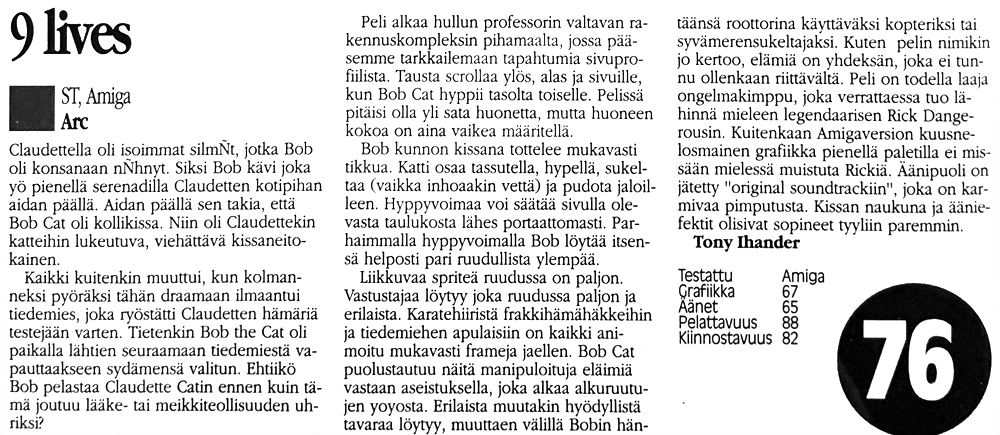
9 lives1991 SyksyPysyvä linkkiClaudettella oli isoimmat silmÑt, jotka Bob oli konsanaan nÑhnyt. Siksi Bob kävi joka yö pienellä serenadilla Claudetten kotipihan aidan päällä. Aidan päällä sen takia, että Bob Cat oli kollikissa. Niin oli Claudettekin katteihin lukeutuva, viehättävä kissaneitokainen.
Kaikki kuitenkin muuttui, kun kolmanneksi pyöräksi tähän draamaan ilmaantui tiedemies, joka ryöstätti Claudetten hämäriä testejään varten. Tietenkin Bob the Cat oli paikalla lähtien seuraamaan tiedemiestä vapauttaakseen sydämensä valitun. Ehtiikö Bob pelastaa Claudette Catin ennen kuin tämä joutuu lääke- tai meikkiteollisuuden uhriksi?
Peli alkaa hullun professorin valtavan rakennuskompleksin pihamaalta, jossa pääsemme tarkkailemaan tapahtumia sivuprofiilista. Tausta scrollaa ylös, alas ja sivuille, kun Bob Cat hyppii tasolta toiselle. Pelissä pitäisi olla yli sata huonetta, mutta huoneen kokoa on aina vaikea määritellä.
Bob kunnon kissana tottelee mukavasti tikkua. Katti osaa tassutella, hypellä, sukeltaa (vaikka inhoaakin vettä) ja pudota jaloilleen. Hyppyvoimaa voi säätää sivulla olevasta taulukosta lähes portaattomasti. Parhaimmalla hyppyvoimalla Bob löytää itsensä helposti pari ruudullista ylempää.
Liikkuvaa spriteä ruudussa on paljon. Vastustajaa löytyy joka ruudussa paljon ja erilaista. Karatehiiristä frakkihämähäkkeihin ja tiedemiehen apulaisiin on kaikki animoitu mukavasti frameja jaellen. Bob Cat puolustautuu näitä manipuloituja eläimiä vastaan aseistuksella, joka alkaa alkuruutujen yoyosta. Erilaista muutakin hyödyllistä tavaraa löytyy, muuttaen välillä Bobin häntänsä roottorina käyttäväksi kopteriksi tai syvämerensukeltajaksi. Kuten pelin nimikin jo kertoo, elämiä on yhdeksän, joka ei tunnu ollenkaan riittävältä. Peli on todella laaja ongelmakimppu, joka verrattaessa tuo lähinnä mieleen legendaarisen Rick Dangerousin. Kuitenkaan Amigaversion kuusnelosmainen grafiikka pienellä paletilla ei missään mielessä muistuta Rickiä. Äänipuoli on jätetty "original soundtrackiin", joka on karmivaa pimputusta. Kissan naukuna ja ääniefektit olisivat sopineet tyyliin paremmin.
9 lives1991 SyksyPermalinkClaudette had the biggest eyes Bob had ever seen. So every night Bob would drop by to sing a little serenade on the fence of Claudette's back yard. On the fence because Bob Cat was a tomcat. And Claudette, too, was one of the moggies: a charming little kitty maiden.
But everything changed when a third wheel turned up in this drama: a scientist who had Claudette kidnapped for his shady experiments. Naturally Bob the Cat was on the spot, setting off after the scientist to free the chosen one of his heart. Will Bob manage to save Claudette Cat before she falls victim to the pharmaceutical or cosmetics industry?
The game starts in the grounds of the mad professor's huge building complex, where we get to watch events side-on. The background scrolls up, down and sideways as Bob Cat hops from one platform to another. The game is supposed to have over a hundred rooms, but the size of a room is always hard to pin down.
Like a proper cat, Bob responds nicely to the stick. The moggy can pad about, hop, dive (even though he hates water) and land on his feet. Jump power can be adjusted almost continuously on a gauge at the side. At top jump power Bob easily finds himself a couple of screenfuls higher up.
There's a lot of moving sprite on screen. Every screen has plenty of enemies, and plenty of different kinds. From karate mice to tailcoated spiders and the scientist's assistants, everything is nicely animated, with frames handed out generously. Bob Cat defends himself against these tampered-with animals with an arsenal that starts with a yo-yo on the opening screens. There's other useful stuff of various kinds to be found as well, at times turning Bob into a copter using his tail as a rotor, or into a deep-sea diver. As the name of the game already tells you, there are nine lives, which doesn't feel anywhere near enough. The game is a truly vast bundle of puzzles which, by comparison, mostly brings to mind the legendary Rick Dangerous. However, the Amiga version's Commodore 64-style graphics with their small palette are in no way reminiscent of Rick. The sound department has been left to an "original soundtrack", which is hideous plinking. Cat meowing and sound effects would have suited the style better.