Galactic Invasion
Pelit was a Finnish-language (bi)annual book series published from 1987 to 1991 containing gaming-related articles, tips and most importantly game reviews. Here you can find all the reviews from the books. The reviews were originally written in Finnish; the English versions are translations of the Finnish originals. Maininta tekijänoikeuksista
 1987
1987 1988
1988 1989 Kevät
 1989 Syksy
 1990 Kevät
 1990 Syksy
 1991 Kevät
 1991 Syksy
Galactic Invasion
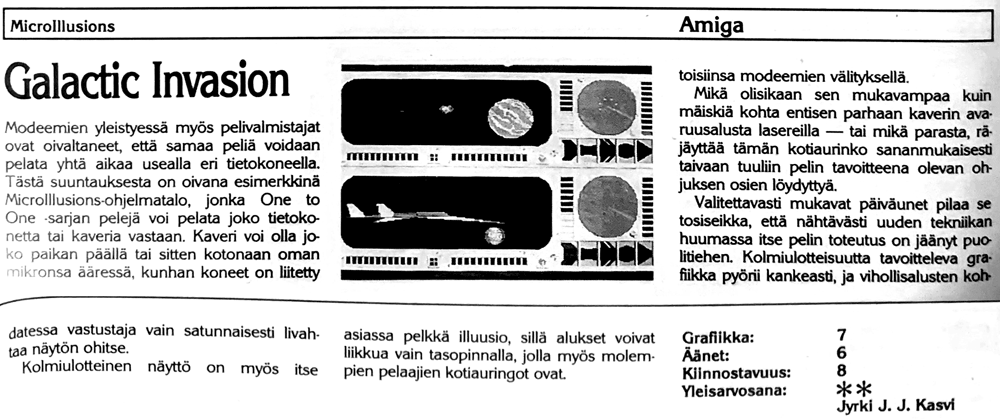
Galactic Invasion1988Pysyvä linkkiModeemien yleistyessä myös pelivalmistajat ovat oivaltaneet, että samaa peliä voidaan pelata yhtä aikaa usealla eri tietokoneella. Tästä suuntauksesta on oivana esimerkkinä MicroIllusions-ohjelmatalo, jonka One to One -sarjan pelejä voi pelata joko tietokonetta tai kaveria vastaan. Kaveri voi olla joko paikan päällä tai sitten kotonaan oman mikronsa ääressä, kunhan koneet on liitetty toisiinsa modeemien välityksellä.
Mikä olisikaan sen mukavampaa kuin mäiskiä kohta entisen parhaan kaverin avaruusalusta lasereilla - tai mikä parasta, räjäyttää tämän kotiaurinko sananmukaisesti taivaan tuuliin pelin tavoitteena olevan ohjuksen osien löydyttyä.
Valitettavasti mukavat päiväunet pilaa se tosiseikka, että nähtävästi uuden tekniikan huumassa itse pelin toteutus on jäänyt puolitiehen. Kolmiulotteisuutta tavoitteleva grafiikka pyöri kankeasti, ja vihollisalusten kohdatessa vastustaja vain satunnaisesti livahtaa näytön ohitse.
Kolmiulotteinen näyttö on myös itse asiassa pelkkä illuusio, sillä alukset voivat liikkua vain tasopinnalla, jolla myös molempien pelaajien kotiauringot ovat.
Galactic Invasion1988PermalinkAs modems become more common, game makers too have realised that the same game can be played at the same time on several different computers. A fine example of this trend is the software house MicroIllusions, whose One to One series games can be played either against the computer or against a friend. The friend can be either right there or at home in front of their own micro, as long as the machines are connected to each other by modem.
What could be nicer than pounding your soon-to-be-former best friend's spaceship with lasers - or, best of all, blowing their home sun quite literally sky-high once you've found the parts of the missile that is the goal of the game.
Unfortunately these sweet daydreams are spoiled by the fact that, apparently in all the excitement over the new technology, the implementation of the game itself has been left half-finished. The graphics, which aim for three dimensions, move stiffly, and when you meet enemy ships, the opponent only occasionally slips past on the screen.
The three-dimensional display is in fact also a mere illusion, since the ships can only move on a flat plane, which is also where both players' home suns are.